 |
Soria and Casa Fuerte de S. Gregorio All photographs by Frits van Krevelen (1998) |
|
| |
Soria and Casa Fuerte de S. Gregorio All photographs by Frits van Krevelen (1998) |
|
Soria was mentioned
for the first time in 869 AD by arab chroniciers for its important strategic situation. It
was conquered by Alfonso-I, called "El Batallador", in 1110 AD and played an
important role in the confrontations between the kings of Castillia and León and the
kings of Navarra. The interventions of Soria to establish the independence of Alfonso-VIII
as king of León after the
death of his father were awarded with privileges to the city of Soria. In 1195 king Sancho
"El Fuerte" of Navarra distroyed the city. It was rapidly rebuilt and during the
last decades of the 12th century many important monuments were established, converting
Soria in a centre of Romanesque art, of which the church of Santo Domingo is one of the
finest examples. On behalf of its unique situation
as gateway between the kingdoms the trade florished, initiated mainly by the many jews,
who settled in Soria after 1195.
After
the expulsion of the jews out of Soria and Spain in 1492 the trade collapsed. The short
revival at the end of the 16th century
could not prevent Soria from its decay, with the conquest by the French troups in the 19th
century as a tragic low. Gradually Soria
recovered from its losses and at the moment it has over 50.000 inhabitants.
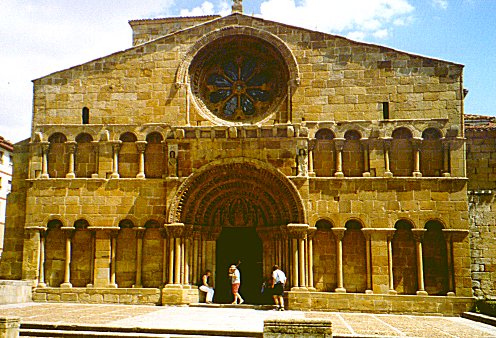 |
The beautiful facade of the Iglesia de Santo Domingo |
The church of Santo Domingo, a national monument, is a
fine example of the Romanesque style of the second half of the 12th century. The beautiful
facade with four archivolts, the large rose at the top of the facade and the rich
decorated entrance are unique. The Romanesque vaults and the rich sculpture is show
influencies of the Saint Marie cathedral of Poitiers, France.
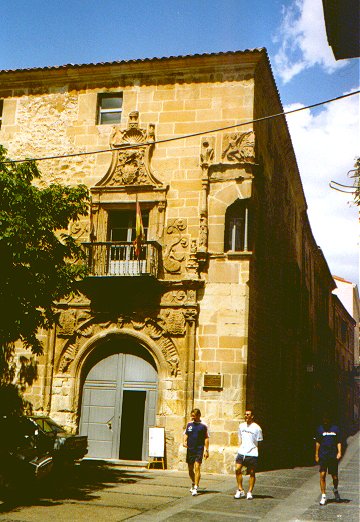 |
Palacio de los Rios y Salcedo |
The Palace of Rios y Salcedo is a splendid example of Spanish Renaissance architecture of the first half of the 16th century. The sculptured gateway in typical Spanish platteresque style reminds of the rich Spanish history as the cultural centre of Europe in those days.
The unusual window at the right corner of the facade with heraldic escutcheons is remarkable. It is a national monument.
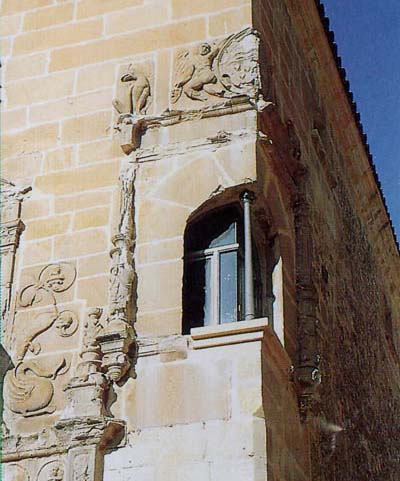 |
The corner window of the Palacio de los Rios y Salcedo |
.
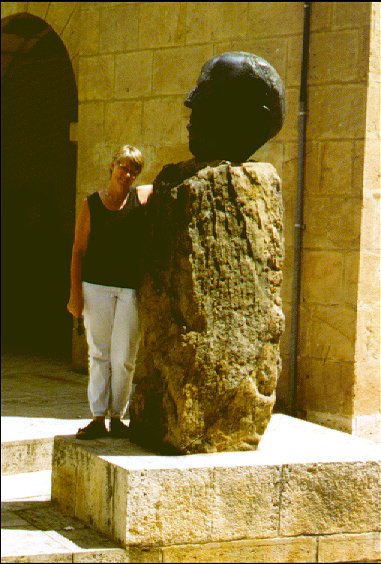 |
Ans standing aside the monument of Antonio Machado |
Antonio Machado (1875-1939), who lived for many years in Soria, is one of the most imporant poets of Spain of the early 20th century.
PROVERBIOS Y CANTARES
XLIII
Dices que nada se pierde
y acaso dices verdad,
pero todo lo perdemos
y todo nos perderá.
PROVERBIOS Y CANTARES
XLIV
Todo pasa y todo queda,
pero lo nuestro es pasar,
pasar haciendo caminos,
caminos sobre la mar.
Antonio Machado
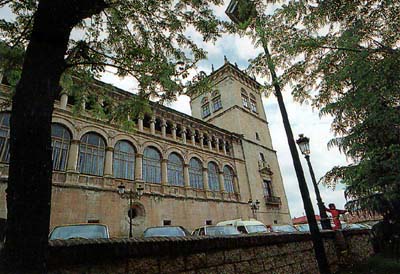 |
Palacio de los Condes de Gómara |
A beautiful example of the civil architecture is the Palace of the Counts of Gómara, who played an important role in the Spanish history. Established in the second half of the 16th century it is typical for the Spanish Renaiscance.
With its large tower and the splendid limestone facade it dominates the city of Soria.Unfortunally we could not visit the beautiful inner square with a splendid arcade.
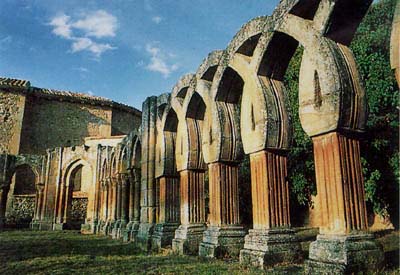 |
The Mozarab arcs of the Monasterio de San Juan de Duero |
The monastry of San Juan de Duero is on of the most remarkable examples of the Romanesque architecture of Spain. Originally it was the monastry of the order of the "Hospitalarios de Jerusalén", of which only the Romanesque cloisters of the 13th century are remaining. There are strong influencies of the mudéjar architecture, also at the crypt below the altar of the 12th century church.
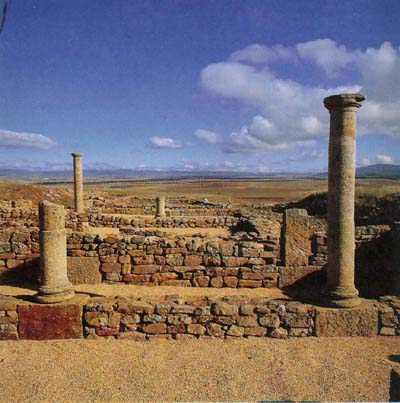 |
The Celtic-Roman ruins of Numancia, Soria |
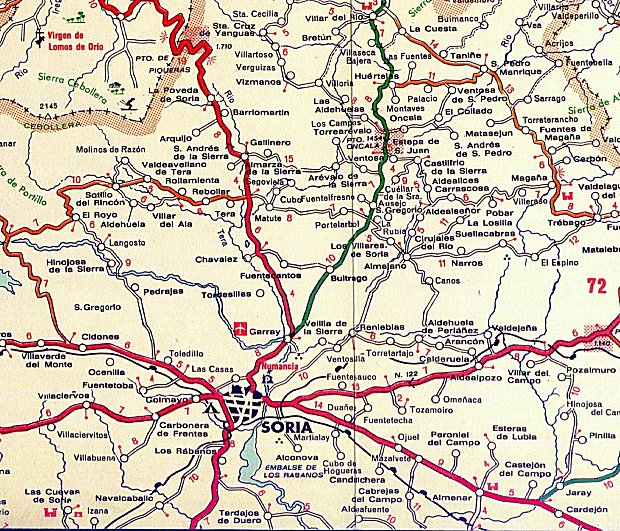
The Celtic-Roman ruins of Numancia At about 7 km north
of Soria on a hill near the village of Garray the ruins of the
Celtic-Roman city of Numancia was excavated, showing parts of its structure and its roadplan.
The city resisted the Roman army for more than one year in 133 BC. Finally the inhabitants
set the city to fire.
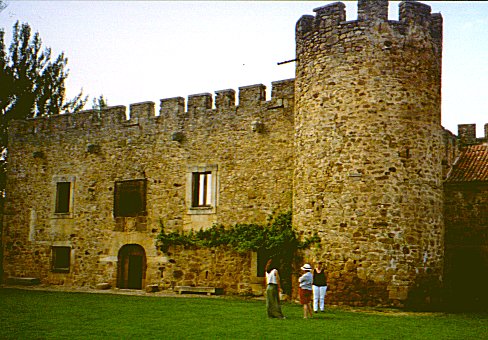 |
The castle of Casa Fuerte de San Gregorio |
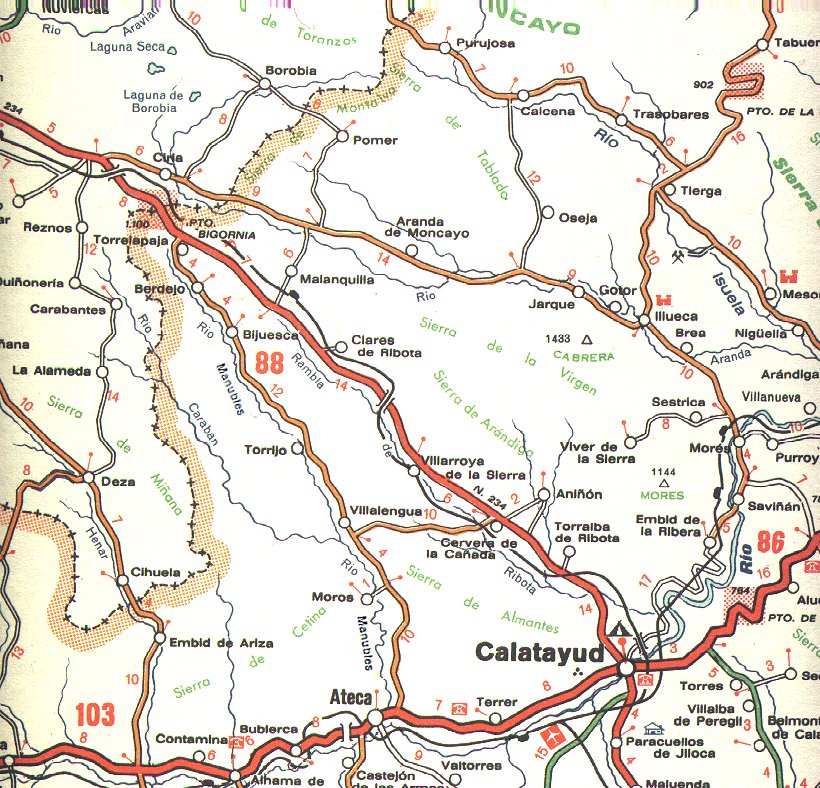
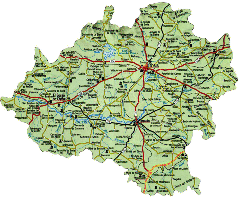
The old monastry of Casa Fuerte de San Gregorio is located near the the road form Soria to Arnedo and Tafalla, about 20 km north of Soria. (see the map at the top of this page)
Built in the 16th century the large monastry with a castle and a church is owned by Don José Vincente Peña Herrador de Casa Fuerte de San Gregorio. This nice and hospitable friend of Carmen Maza received us for a visit to his beautiful castle and a trip by jeep over the estates. It is a place of history an mistery as well. Nowadays it is known as the source of the most exquisite sheep cheese of Spain. It is a pity that costs of the maintenance of this splendid estate tend to become too high in these modern times.
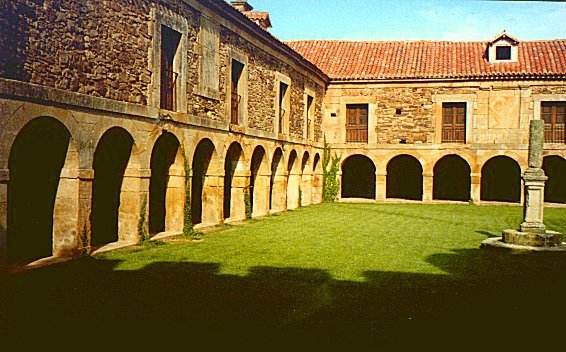 |
The cloisters of Casa Fuerte de San Gregorio |
The cloisters of Casa Fuerte de San Gregorio are preserved partly.
The building is now in use as a cheese factory. Over 2000 5-pound cheeses are fabricated
of the finest milk of the Australian sheep flock.
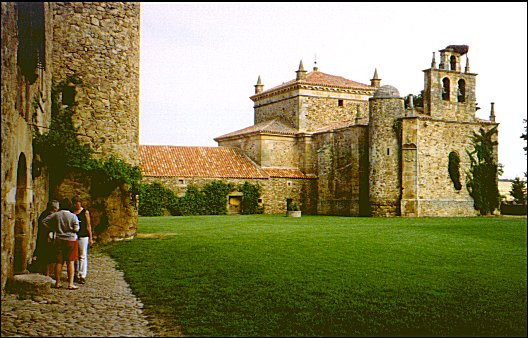 |
The church of Casa Fuerte de San Gregorio |
A
look at the old church of Casa Fuerte de San Gregorio. Carmen and Ans in conversation with the mother of Don Vinciente.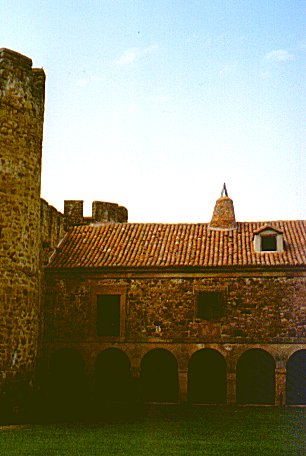 |
The historic conical chimney of Casa Fuerte |
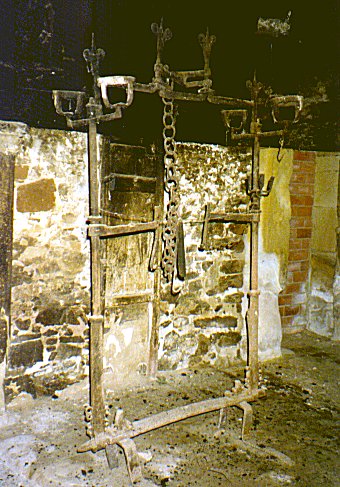 |
The original kitchen of Casa Fuerte |
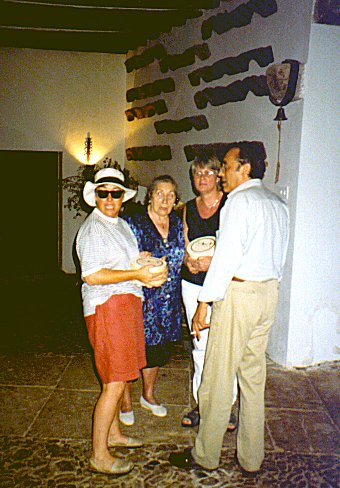 |
Don Jose, his mother, Ans and Carmen |
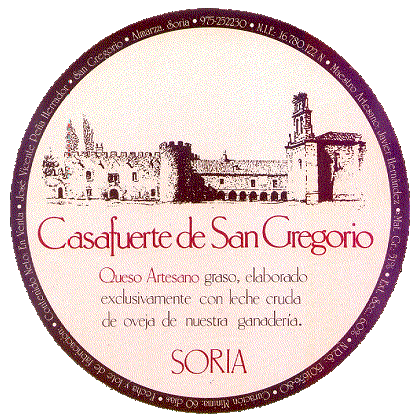
Finally we bought some cheese to take with us to Holland. It is (was) *really* delicious. It was a splendid day and a very nice visit to these hospitable people.
Look
below for the label of the best sheep cheese of Spain today
Back to the top of this page