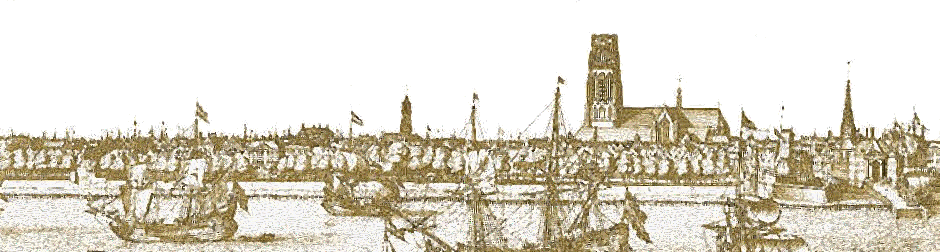
Rotterdam has always been a port city.
Situated near deep water, easily accessible from both the North Sea and from inland, it
was in a perfect position to become the largest port in the world. And that is what
happened.
 |
Parkkade |
When we
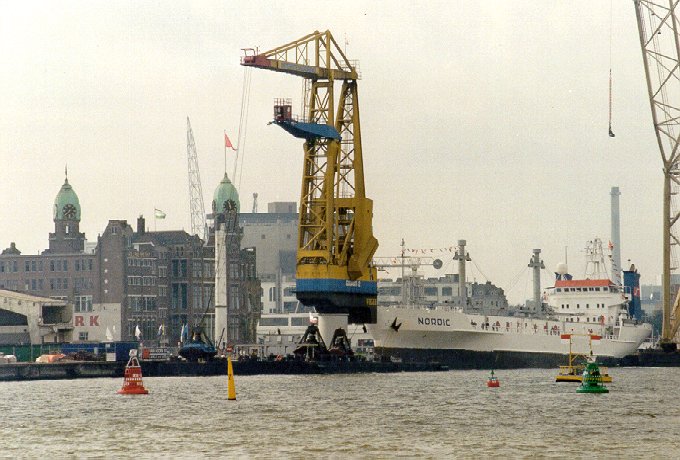
talk about the "Port of Rotterdam" we don't mean a single harbor. Instead, the
term has come to encompass the whole range of harbor complexes, from those in the city
itself right up to the coast. The harbors in the city (the largest of which are the
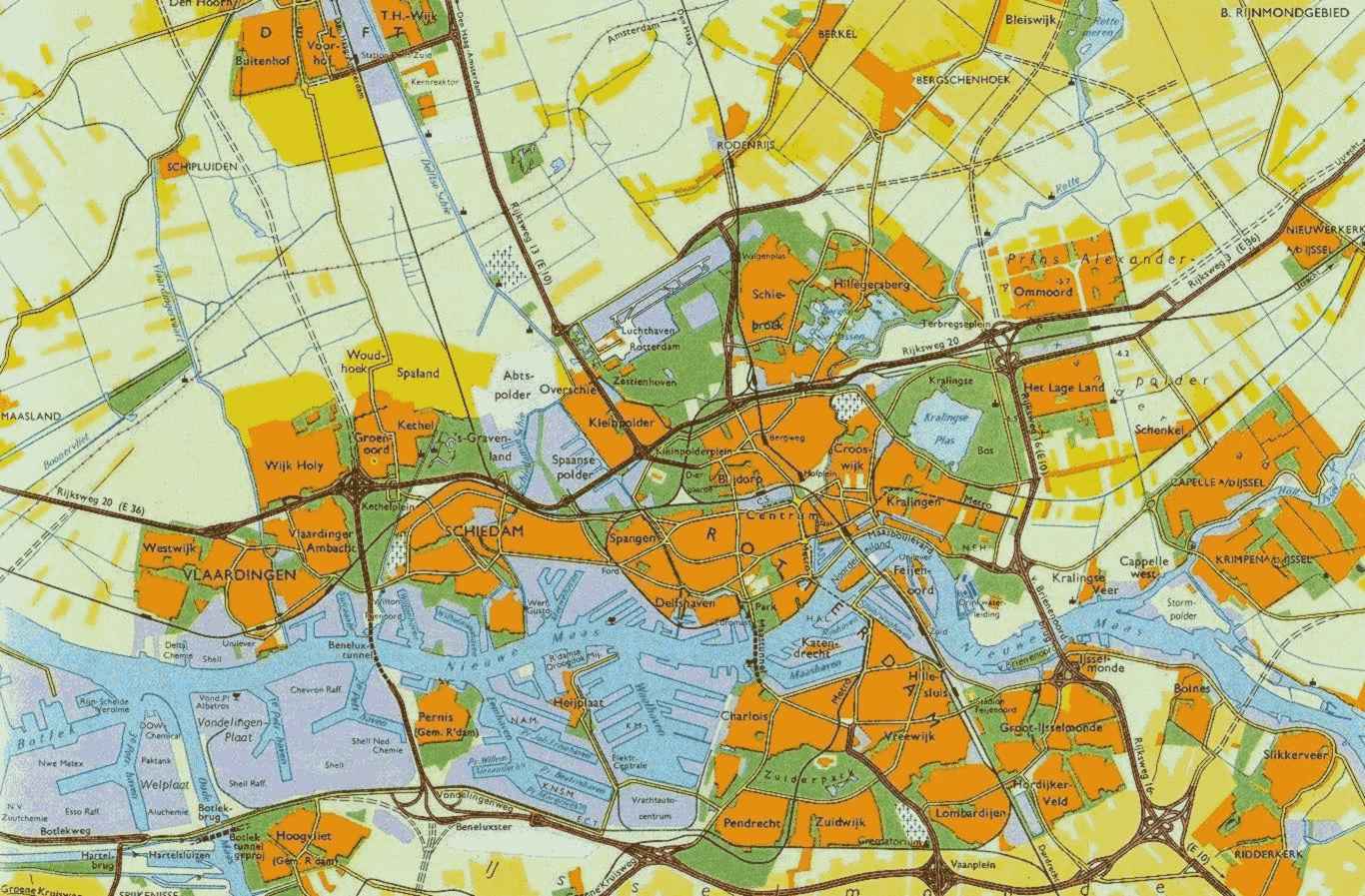
Rijnhaven, Maashaven, Waalhaven and Eemhaven, though there are many more) are the older
ones, and they service the smaller ships. Most of these ships transport goods further into
Europe across the rivers.
The growing demands of international transport led to larger ships, which in turn required
larger ports and deeper water. To increase its port capacity, Rotterdam needed more deep
water and a solid infrastructure to support these new ports. Along the banks of the Maas,
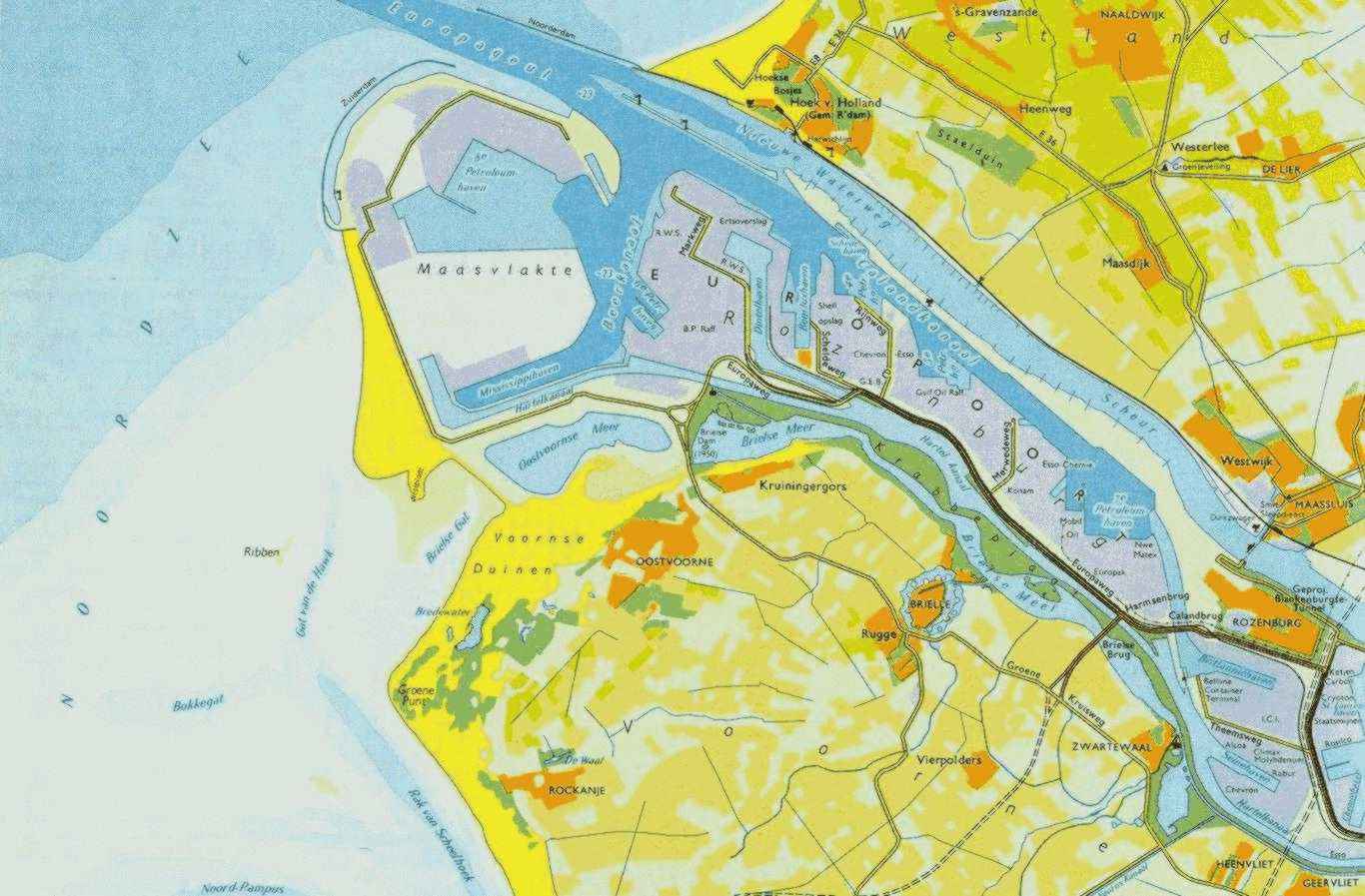
the Europoort ('Euro gate') complex
developed.
 |
 |
Port of Rotterdam: the Europoort region
|
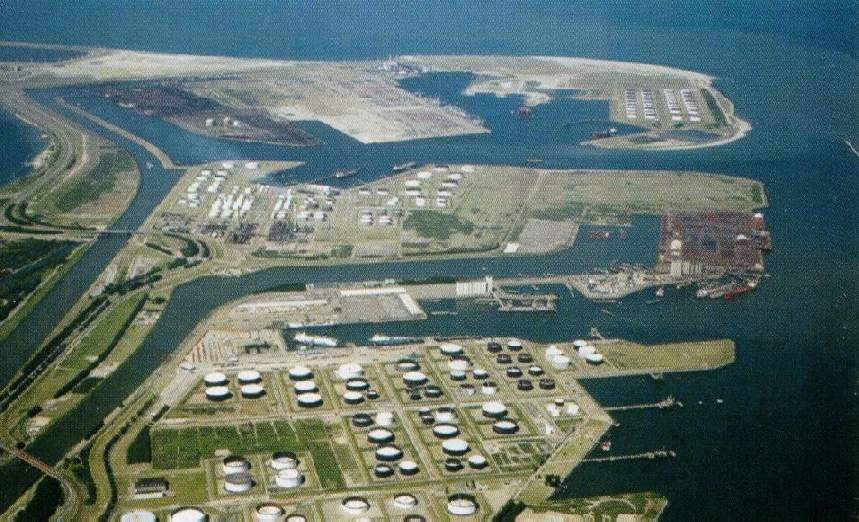 |
Maasvlakte. The largest, deepest ports are located here. |
The
deepest ports are of course the ones closest to the shore. The largest one is the 8ste
Petroleumhaven (8th Petrol Harbor), which is in fact located outside the Dutch coastline.
This is where supertankers, mostly from the Persian Gulf, are unloaded. Note the large
circular tanks (with a total storage capacity of millions and millions of gallons), part
of the Maasvlakte Oil Terminal (MOT) and
various oil companies. These tanks are used for the storage of crude oil.
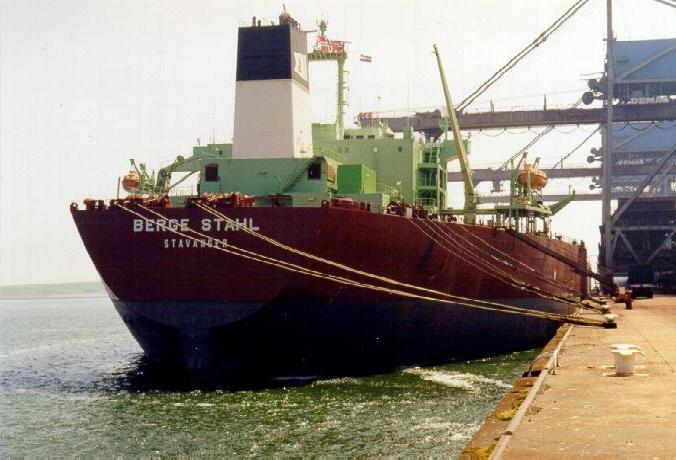 |
The 'Berge Stahl' at the EECV terminal |
A good
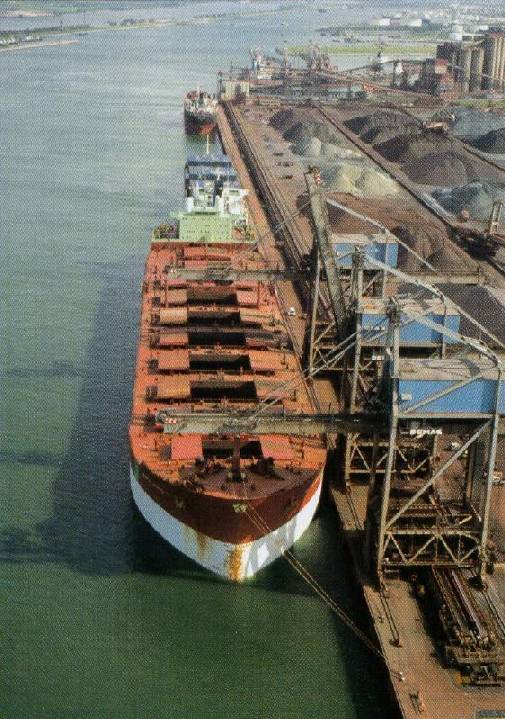
second is the Missisippihaven, where a very large ore terminal is located. At the EECV terminal in the Caland channel even the
largest bulk carriers can be serviced. Super-carriers like the Berge Stahl are dependent
upon this terminal, as it is the only one in Europe that can be accessed by ships this
large.
|
The bulk carrier Berge Adria (scheduled to be decommissioned in February 1998) is being unloaded at the Ertskade Europoort |
Of
course ore isn't the only commodity that is tranferred in bulk. Coal and scrap metal are
equally important, as are agricultural goods and other bulk dry cargo. The Europoort
region is the most important mass goods transfer location in Europe. The largest terminals
here are primarily dedicated to the handling of ore and coal. The coal terminal is not
only used to forward coal inland, but also to provide the Maasvlakte power station with
fuel. An underground conveyor belt transports coal straight from the bulk carriers into
the bunkers of the power plant. This station produces the electricity that powers the
entire industrial area, although it is of course locked into the national power grid, so
that excess power is fed into the grid or extra power is drawn from it, depending on power
production and consumption.
|
Ore on its way to Germany |
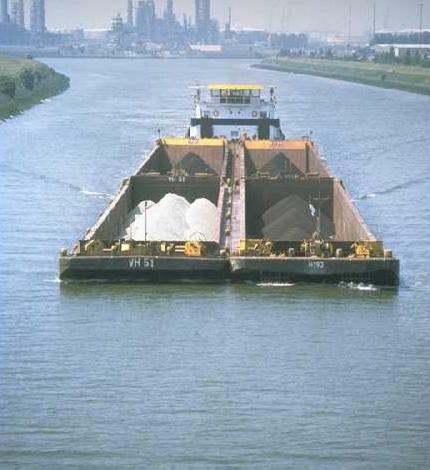
The bulk
of the incoming ore and coal is transferred into smaller ships, barges and trains, which
take care of further transport into Europe. Much of the ore goes to the Ruhr region in
Germany to feed the smelters of the German steel industry.
 |
Container transfer at the Europe Container Terminal |
Apart
from fluid and dry bulk goods, general goods also are an important part of the total
amount of goods transferred in the port of Rotterdam. In the general goods sector,
containers have become more and more important, since containers can be shipped much more
efficiently than separate goods. Containers come in only two standard sizes, 20 and 40
ft., which makes it possible for container ships to be be stowed without wasting any space
at all.
Most of the containers are transferred at the Europe Container Terminal, where automated
cranes and computerized lorries handle containers with a minimum of human intervention.
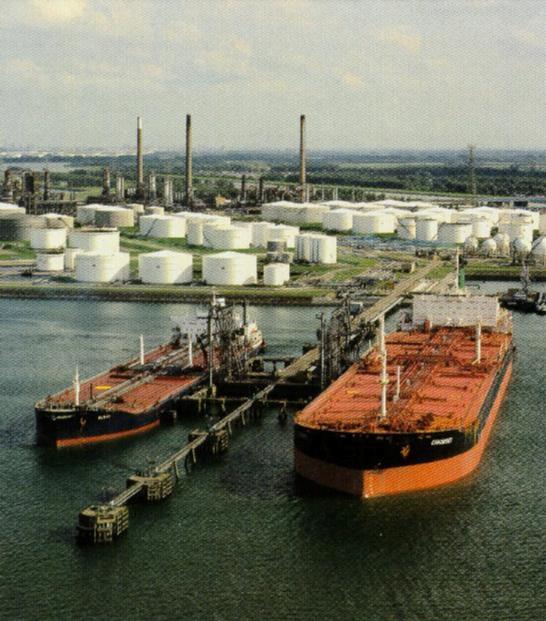 |
Botlek: a mix of harbor and industry |
The
ports further inland are somewhat smaller. Most of the chemical industry around Rotterdam
is located in this area. The five large petrochemical companies (Shell, BP, Esso, Kuwait
Petroleum and Texaco, in no particular order) have refineries here, and over 20 large
chemical companies have their various processing plants in all shapes and sizes. These
companies are fully dependent upon the port of Rotterdam to provide them with raw
materials (mostly crude oil) and upon the logistics of the entire sector to distribute
semi-finished and end products between plants and companies. Extensive piping systems
transfer the chemicals from plant to plant, so that one installation can take in crude oil
and produce derivatives, and then pipe those directly into the next plant where they are
processed further into end products.
All this
shipping, transferring, storaging and forwarding create their own logistic problems.
Needless to say that both roads and railways in the area must be expanded regularly to
cope with the growing need for transportation. Be it dry bulk or fluid, containers or
cars, cocoa, coffee or tropical fruit, the port of Rotterdam can handle it all. The
enormous amount of goods that passes through this port (some 300 million metric tons a
year) truly make the port of Rotterdam live up to its reputation: Gateway to Europe.