 |
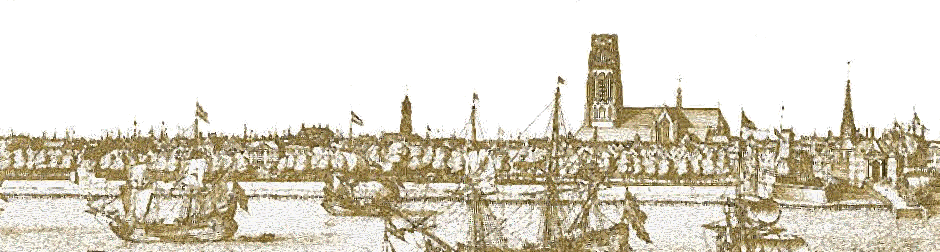
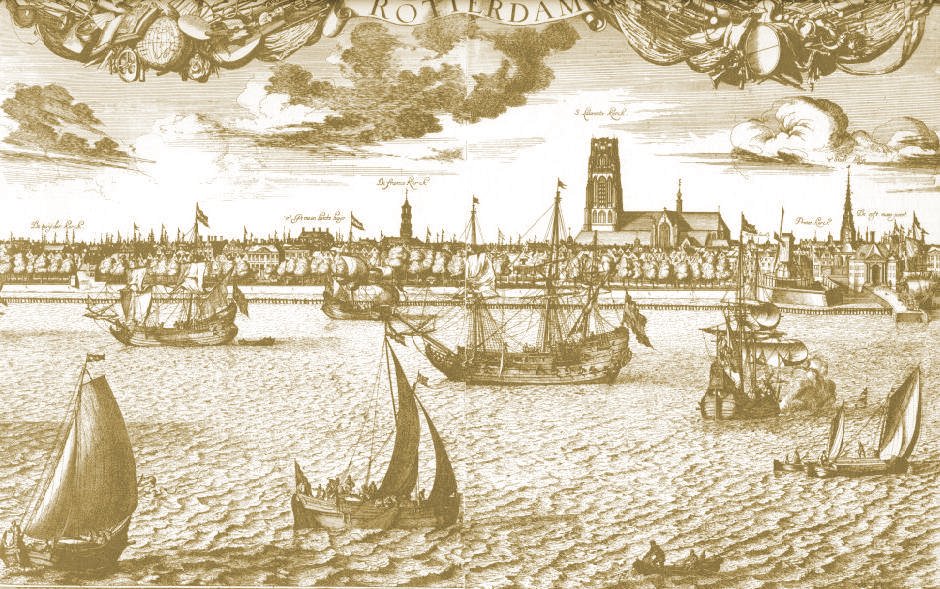
Rotterdam seen from the river Maas. Etch by Joost van Geel, published along with a map of the Maas by Jacob Quack in 1667 |
Initially Rotterdam was just a small, quiet fishing harbor in a bend in the Rotte. It slowly grew, but on the whole it remained a town of very little significance, especially when compared to its main competitors Delft and Dordrecht, which were much more important in trade and industry in those days. But Dordrecht suffered severe damage from the St. Elisabeth flood of 1421, while Delft failed to excavate the larger harbor it needed to support the trade, mostly as a result of internal political machinations.
Rotterdam
had no such problems: its position near to deep water was much better than that of its
competitors, and it had a readily accessible harbor. Trade flourished, and many goods
started to pass through Rotterdam on their way to and from the ships that frequented her
harbor. In 1488, the bands of Frans van Breederoode did severe damage to the city, looting
and burning large parts of Rotterdam. Fortifications were built, and he city became
slightly smaller in order to become more defendable. In 1563 a large part of the city
burned down completely. However, in spite of all these things trade continued and grew. In
the 1570s, during the war with Spain, Rotterdam managed to fortify its position as a port
of trade, when it became one of the few ports open to the sea. Antwerp and Amsterdam were
being blocked because of the war. Explosive growth followed. The city expanded, the walls
around it were torn down as soon as the dangers of war diminished, and new harbors were
excavated, especially during the 17th century.
In the
18th century the population of Rotterdam no longer grew significantly, but remained
stationary around an estimated 50000 people. Only in the 19th century, when the port
facilities were enlarged again, it started to boom once more.
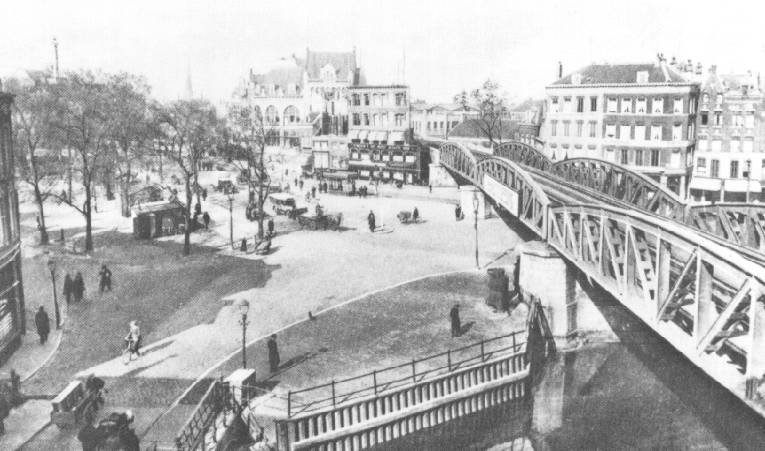 |
Hofplein in 1939. Note the elevated railway on the east side of the square. |
Rotterdam embraced the industrial revolution of the 19th century. Steam power and mechanization boosted the capacity of the port enormously, while railroads took care of transport of the goods over land. An elevated railroad using the latest techniques for steel construction was built, and steam-powered harbor cranes speeded up the loading and unloading of ships tremendously. Means of transport and an infrastructure to handle the flow of goods from one place to another became increasingly vital. Steel bridges were built to connect both sides of the River Maas. The Nieuwe Waterweg ('New Waterway') was completed in 1872, which gave Rotterdam a direct, high-capacity connection to the North Sea. As often happens during periods of rapid expansion, older buildings were often sacrificed to make way for new ones. This process continued well into the 20th century.
The
Depression of the 1930s struck hard in Rotterdam. Unemployment became commonplace and
poverty led to civil unrest, which was at times violently suppressed. By the end of the
1930s, however, the port of Rotterdam was slowly recovering, though unemployment was still
high and the standard of living, especially among those of the 'working class' left a lot
to be desired.
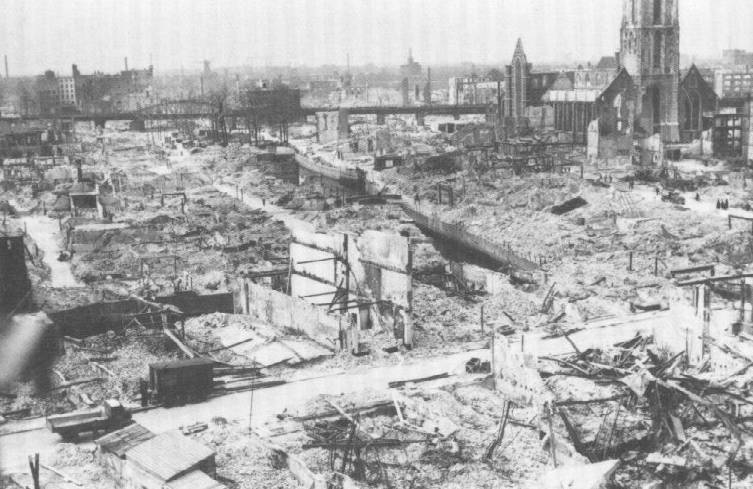 |
The heart of Rotterdam shortly after the 1940 bombardment |
Then
World War II broke out. On 10 May 1940, the German army attacked the Netherlands. Part of
the German 'Blitzkrieg' strategy was an extensive bombardment on the heart of Rotterdam on
14 May. Blockbusters and firebombs laid the heard of the city to waste. Casualties were
numerous. Clearing away most of the rubble took over a year. The Dutch government was
forced to capitulate after only five days of war in order to prevent further bloodshed.
After five days of war five years of German occupation followed. But the damage had been
done, and of all Dutch cities none suffered as greatly as Rotterdam did. The heart of the
city was gone completely, most of it burned down during the firebombing in 1940 and the
rest torn down because of severe structural damage and the subsequent danger of collapse.
After the German capitulation in 1945, the process of rebuilding the city began. Slowly at
first because building materials were in very short supply, while the demand was enormous,
as Rotterdam had literally become a 'city without a heart'.
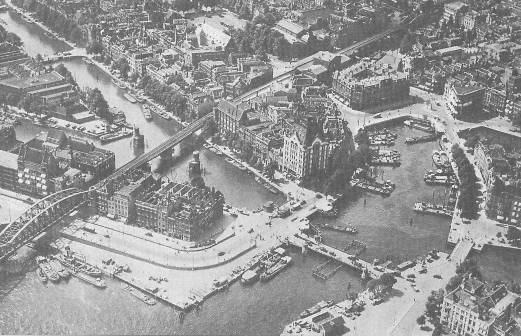 |
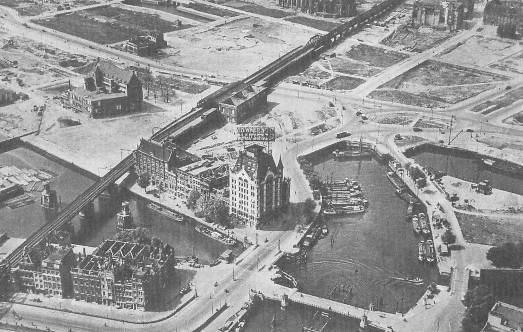 |
Oude Haven (note the 'White House' in the middle) before the war |
The same part of Rotterdam, shortly after the end of the war in 1945 |
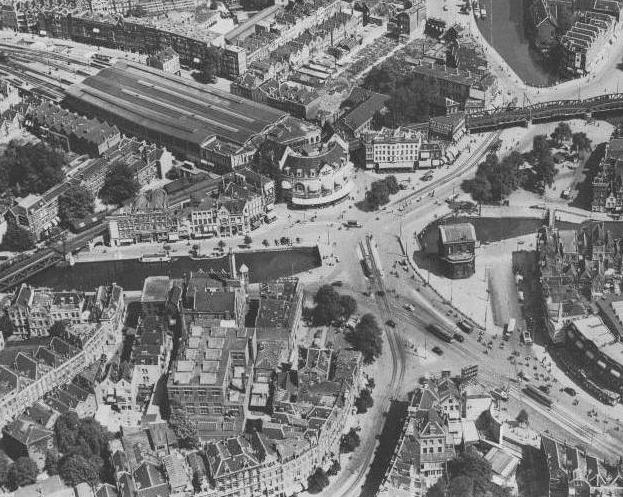 |
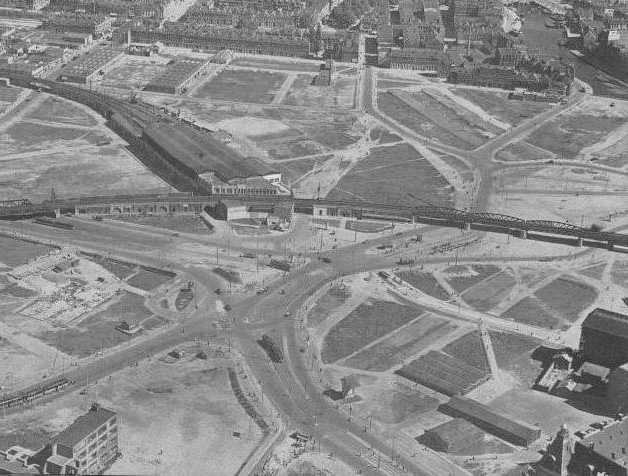 |
Hofplein station before the war |
Hofplein station after the war |
The
Russian/French sculptor Ossip Zadkine, seeing the wasteland that had once been the heart
of Rotterdam, was inspired to create his statue 'The Razed City' ('City without a heart')
in 1946, now considered to be one of his most important works of art. It's interesting to
note that Zadkine intended this statue to be placed in the center of an otherwise empty
square, as a referral to the bombed-out wasteland with a single building left standing in
the middle. Initially the statue was placed on such a square, but as the demand for
building space increased, such room was no longer available, and nowadays the statue has
no such freedom. Though this is not what Zadkine had intended, it is typical for the
spirit of Rotterdam to go on, eyes firmly fixed upon the present and the future, and not
to linger in the past.
The
period that followed World War II has been one long construction project. Disastrous as
the 1940 bombardment has been, it did provide architects with a truly unique opportunity:
the chance to reconstruct the heart of a large city from scratch. And that is exactly what
they did.
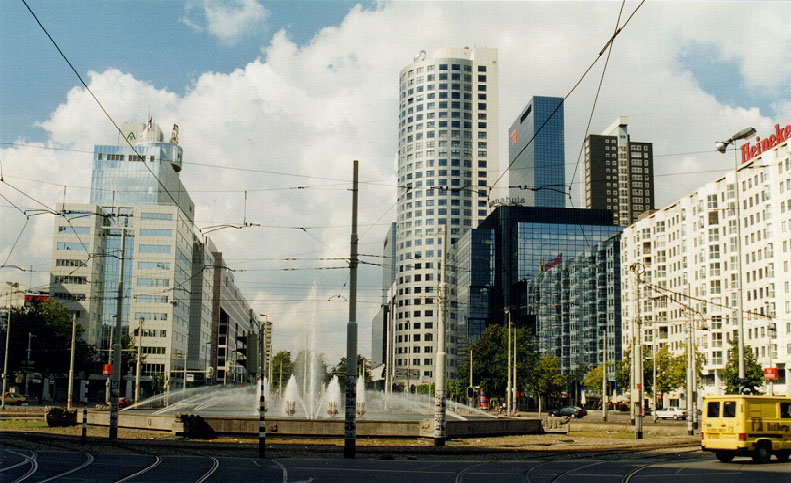 |
| Hofplein in the 1990s. Compare this with the 1939 picture above! |
Especially
during the 1950s and 1960s, many new buildings were constructed to fill up the empty
spaces between the older buildings that had survived the war. This created a curious mix
of old and new, buildings dating back to the turn of the century (or older) standing side
by side with the latest architectural styles. Some would say that the 'fever' of
reconstruction has gone out of hand, since several of the buildings that were erected in
the fifties have already been torn down again to make way for newer, bigger and even more
modern buildings. Apart from that, the ongoing work of reconstruction has the city
cluttered with building traffic more often than not, while-closed down roads and detours
are common in Rotterdam. Especially in the sixties, one could work in Rotterdam for five
years without being able to take the same route from home to work for more than two or
three months. Nevertheless, the post-war reconstruction has given Rotterdam its unique
architectural character. The process of construction and improvement still continues.
Though it should be mentioned that some do not consider this an improvement at all. The
sad fact remains that Rotterdam as it was before 1940 is gone forever, and the post-war
Rotterdam is not the same as it once was.
* * *
Nowadays Rotterdam is a vital part of the economy of the Netherlands. The Port of Rotterdam, the largest port in the world with a total throughput of about 300 million metric tons a year provides a solid base for industry in and around the Rotterdam area. Its population is about 575000, which makes it one of the largest cities in the Netherlands, but the number of people that work in the Rotterdam area or are otherwise economically dependent of it exceeds that number by far. The density of population is among the highest in the Netherlands, exceeding 4000 per square kilometer.
Shipping,
storage and forwarding are of course among the most important activities in the region,
but the port of Rotterdam has also created a large chemical industry, which is fully
dependent upon the transport facilities for the inflow of raw oil and the shipping of the
various refined end products. Large petrochemical plants have sprung up, especially on the
south bank of the Maas. These plants are in operation 24 hours a day. The development of Europoort ('Euro gate') started in 1957. A large
complex of ports and industrial areas was created between Rotterdam and the entry to the
North Sea. When more space was needed, the Maasvlakte ('Maas Flats') was created. By means
of dikes, dams and sand deposits the coast line was altered to include many square
kilometers of newly created land, where the Petroleum Harbors, container terminals, ore
terminals and the Maasvlakte power plant are located. An interesting feature is the
'disaster area', a training complex where fire brigades train to cope with large-scale
industrial accidents. The complex includes a grounded tanker that is set on fire several
times a day.
The name
Europoort suggests that Rotterdam wanted to become the gateway to Europe. By 1963 this
suggestion had become outdated, because in that year Rotterdam could claim to be the
largest port in the world, a record that it still holds. In fact, the Berge Stahl, a 365000 ton ore carrier,
is fully dependent on the port of Rotterdam, since this is the only port on the European
continent that this ship (with its 23m/75ft draught) can
access. After the flood in 1953 a large project was initiated to prevent such floodings in
the future. This project, the 'Delta plan', involved stronger and higher dikes and
numerous flood barriers. The latest of those flood barriers to be completed was the storm
surge barrier in the Nieuwe Waterweg near Hoek van Holland. Two enormous doors mounted on
swing arms can be used to close off the Nieuwe Waterweg, should storm and high water
require so in order to protect the country from flooding. Normally the doors are open, so
as not to impede the flow of ships through the Nieuwe Waterweg.
Building
and development have become a way of life for Rotterdam. The city has continued to grow,
and it shows no signs of slowing down. And although this constant increase of population,
urbanization and development all breed their own problems, Rotterdam is ready for the next
millenium. As the economic heart of the Netherlands, with a population heading towards
600000, it had better be ready.


