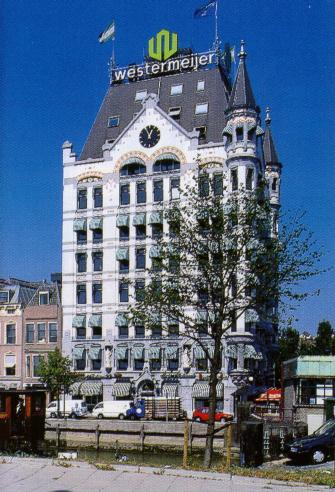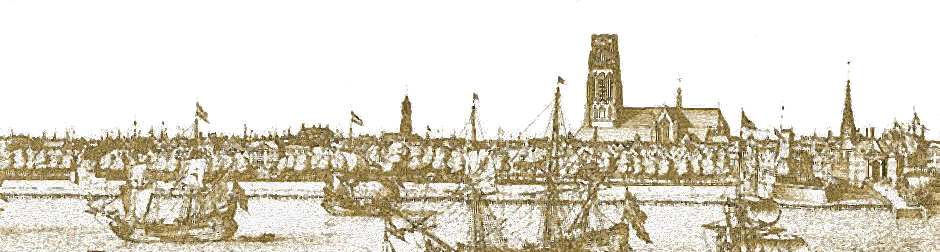
Rotterdam is a city of infinite variety, a
city with a thousand faces. It is impossible to capture it in words or even in pictures,
so only a few of the best photographs on the net are selected for this virtual tour. Sit
back and enjoy!
Rotterdam is built
on the banks of the river Maas. Bridges across and tunnels under the Maas connect north
and south, thereby forming vital links in the ever-increasing city traffic.
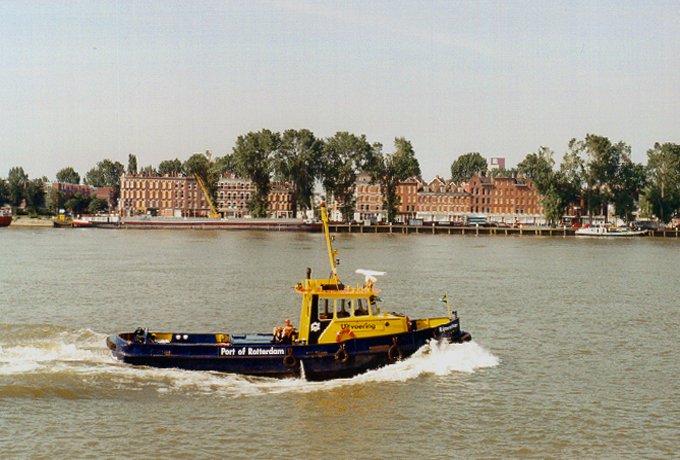 |
Maas, with the Noordereiland in the background |
Tugs
like this are a common sight in Rotterdam, as are the boats of the Municipal Port
Management. Here we see the river from the north bank. In the background we can see the Noordereiland ('Northern island'). The buildings
on the Noordereiland, mostly former warehouses, have been renovated and are now in use as
offices and appartments.
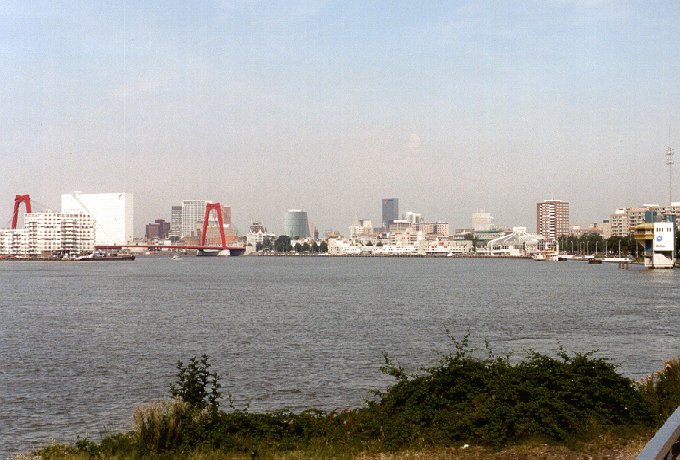 |
Willemsbrug, seen from Maas boulevard |
The Willemsbrug ('Willems bridge') is an important
link for car traffic across the Maas. Suspended between its two characteristic red pylons,
the Willemsbrug has become a well-known landmark, and a popular subjects for picture
postcards from Rotterdam. *) The original
Willemsbrug was built in 1878. This one was completed in the 1980's. At right the
Willemsbrug at night.
| * |
|
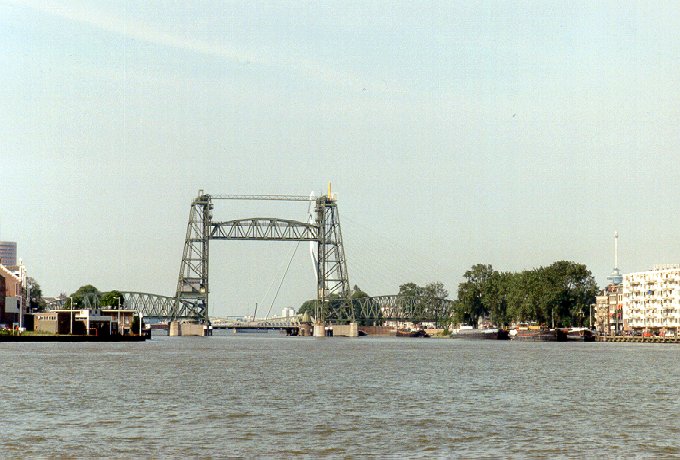 |
De Hef, the now decommissioned railway bridge |
Since
the recent completion of the railroad tunnel under the Maas, De Hef ('The Lift') has been
decommissioned. Completed in 1927, it has been preserved as an industrial monument. It is
now permanently open.
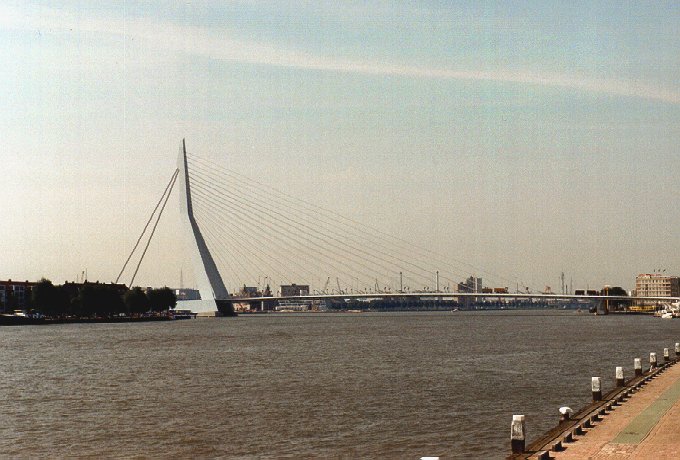 |
Erasmusbrug (nicknamed "The Swan") |
Rotterdams
latest bridge, the Erasmusbrug ('Erasmus
bridge') was officially opened in september 1996. Recently there have been some problems
with the suspension cables of the bridge, which show a disturbing tendency to vibrate
whenever a combination of heavy rain and strong wind occurs. Its nickname, the Swan, refer
to its gracious design and the single support pylon. The Erasmusbrug has been included in
the Rotterdam marathon circuit since 1997.
 |
The Willemsbrug and (former) railroad bridge. |
Here we
can see the railroad bridge across the Maas, leading to De Hef, the moving section in the
railroad bridge. This part of the bridge has been removed after the completetion of the
railroad tunnel.
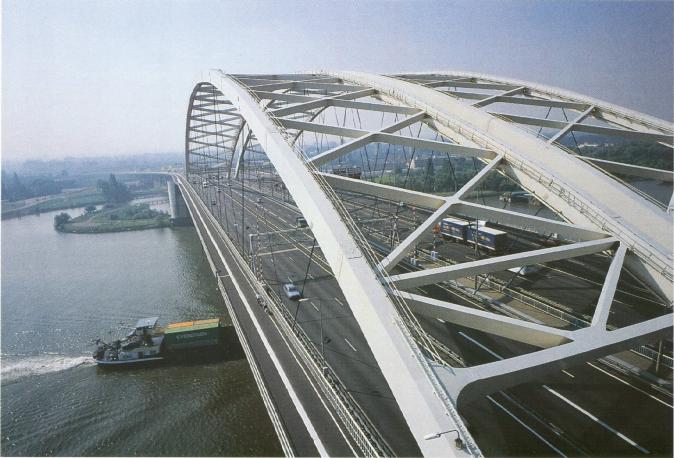 |
The Van Brienenoord brug |
On the
east side of the city the Van Brienenoord bridge
carries the heaviest traffic load of all bridges in Rotterdam. Along with the Benelux
tunnel on the west side, this bridge is a major link in the network of roads around
Rotterdam. Traffic that passes Rotterdam in a north/south direction needs to go across
this bridge or through the tunnel in order to get across the Maas.
The heart of Rotterdam was completely destroyed in 1940 when World War II began. (See also the 'History, facts & figures' page.) After the war, it had to be rebuilt completely. This provided architects with wonderful opportunities.
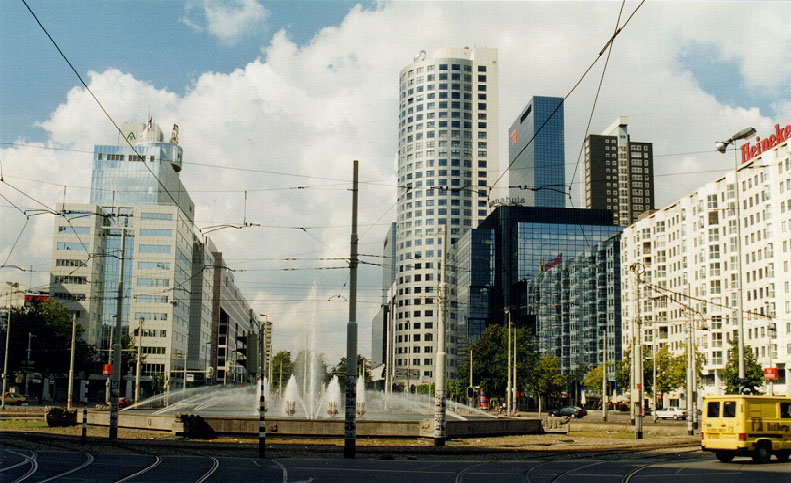 |
Hofplein |
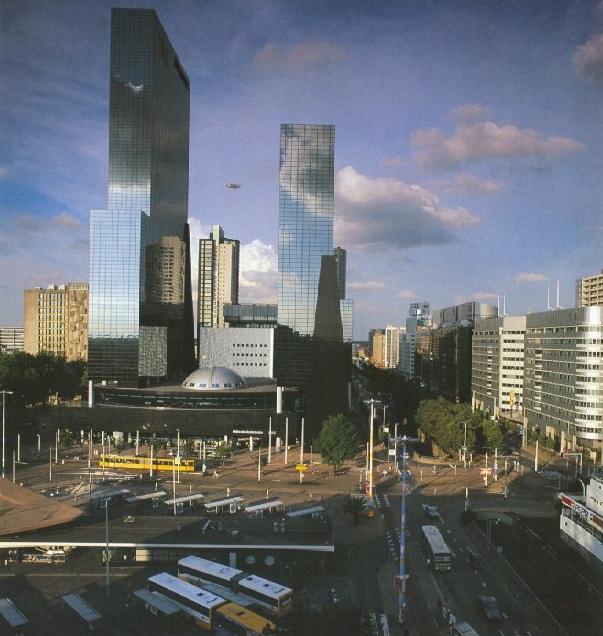
The Hofplein ('Court square') is dominated by glass, steel and
concrete. Slender office towers, among the highest buildings in the Netherlands, rise up
from the heart of the city. Although these buildings can't even begin to compete with the
skyscrapers in the US after which they were modeled, the style is essentially the same.
 |
Office towers near Rotterdam Central Station |
Extensive
use of mirror glass gives the office towers a polished, hi-tech look. It's interesting to
note that this style became popular while the soap series 'Dallas' was aired in Holland.
Therefore this design is sometimes called the Dallas-look.
 |
Coolsingel |
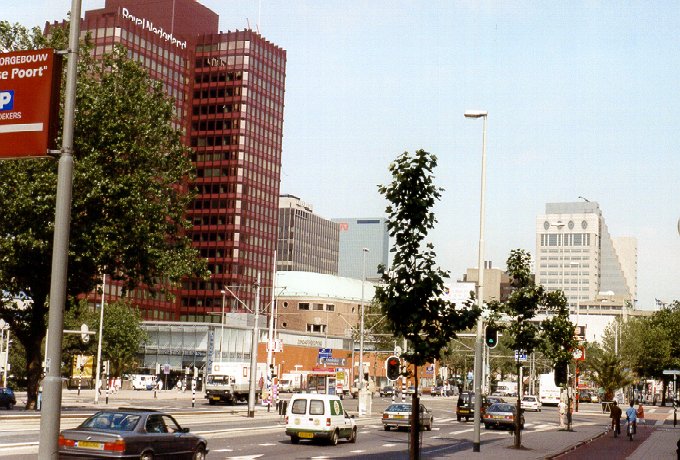
The Coolsingel,
leading south from the Hofplein, is a broad street flanked by office buildings and shops.
As the name suggests ('singel' means 'moat') the Coolsingel used to be water, but it was
filled up during the previous century when road traffic in the city became more important
than traffic by water. Before the war, the Coolsingel was lined with bars, restaurants and
theaters. After the war these were replaced with shops and offices.
 |
Cubes and pencils: an unusual piece of architecture |
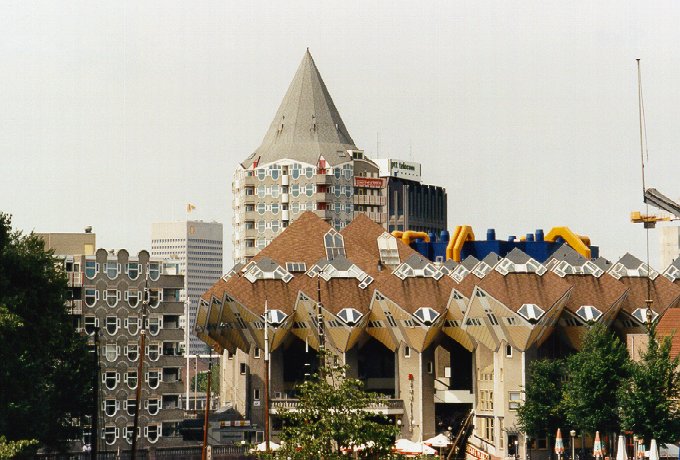
The Cubes are a good example of new architecture in
Rotterdam. Designed by architect Piet Blom, these houses are fairly unique. The building
in the background is called The Pencil, for obvious reasons.
The blue roof and yellow tubes that are just visible above the cubes are part of the
public library building. The ducts are part of the airconditioning system and have been
painted in contrasting colors in order to attract attention rather than to be camouflaged.
 |
Maritime museum 'Prins Hendrik', Leuvehaven |
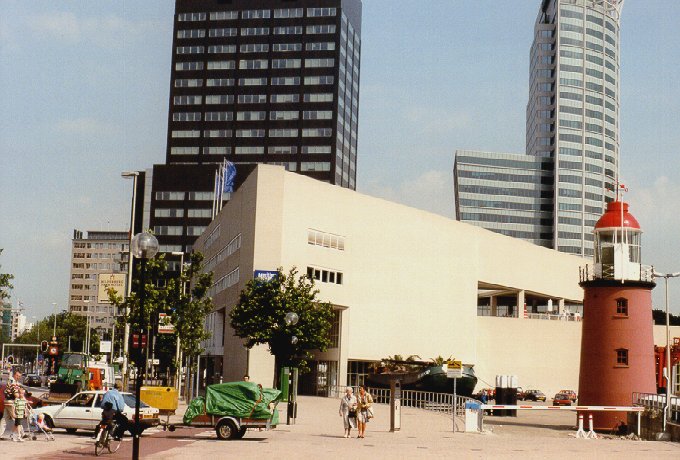
The Maritime museum is located at the Leuvehaven ('Leuve
harbor'). The harbor itself is given over to the open air section of the museum, which
features antique port equipment including steam-powered cranes and vessels. A former
battering ship of the Royal Dutch Navy is also on display here. The building on this
picture houses the interior part of the museum. The modern design of the building
contrasts sharply, but not unpleasantly, with the antiquated equipment on display right
next to it. The small lighthouse used to be a harbor light, now preserved for posterity in
the museum.
|
The Euromast: a room with a view |
The Euromast ('Euro tower') was build in 1960 on the
occasion of the Floriade, a large horticultural event. The upper section (the Space Tower)
was added ten years later. On a clear day, the view from the top at 185 meters above sea
level is spectacular, although clear days have become rare because of smog and air
pollution in general.
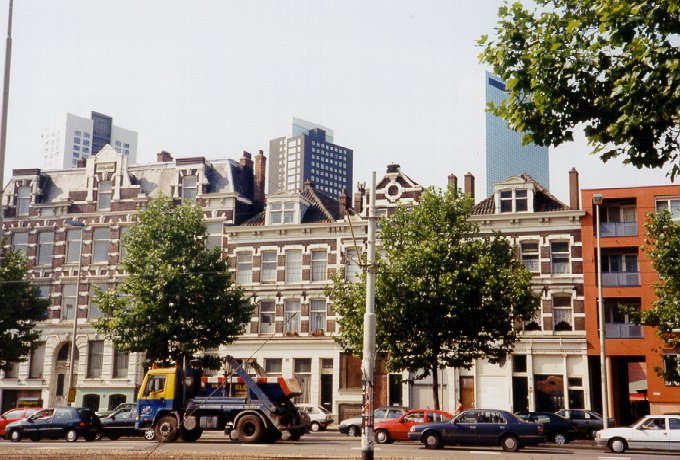
Any city that wasn't built in a day has older and newer buildings standing side by side. This gives a (sometimes uneasy) blend of old and new styles. Rotterdam has more than its share of such contrasts.
 |
Schiekade |
Sometimes
the curious mix of old and new in Rotterdam can be quite striking. Antique facades may be
standing side by side with new, no-nonsense concrete. And the office towers are always
present in the background.
 |
Goudsesingel |
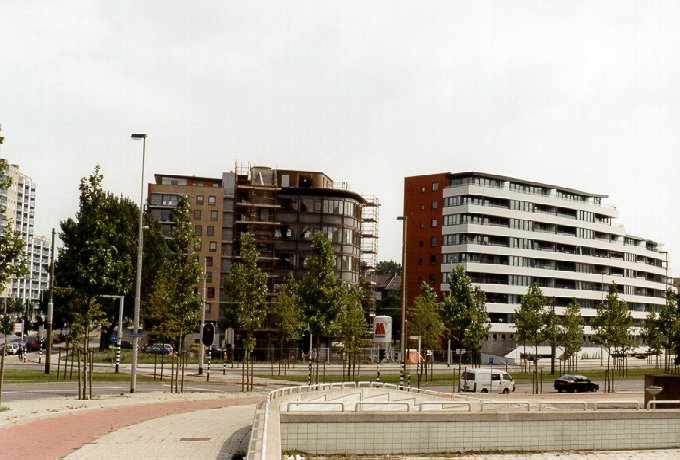
Another
example of such contrasts can be found at the Goudsesingel.
The rounded building to the left is the former Nederlandse Incasso Bank, designed by
architect Van Veen. It was built in 1940 and survived the war unscathed. It is now an
architectural monument. The white, lens-shaped building next to it is a new apartment
building, completed in the nineties.
 |
Hotel New York, formerly the head offices of the Holland America Line |
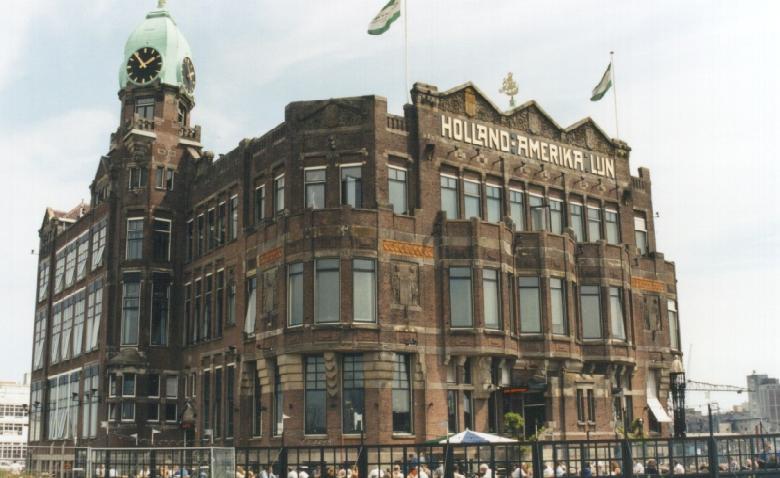
For many
decades a steady stream of migrants to the US departed from Rotterdam. The Holland America Line was the most important
passenger company between Europe and the 'new world'. Nowadays, the former HAL building is
in use as Hotel New York.
|
Het Witte Huis |
Het Witte Huis ('The White House') was completed in
1898 and is 45 meters high, at the time the hightest building in Europe. It was one of the
few buildings in the district to survive the 1940 bombardment. (See also the historical
section for pre- and postwar pictures.)
 |
The Oude Haven: bars and restaurants |
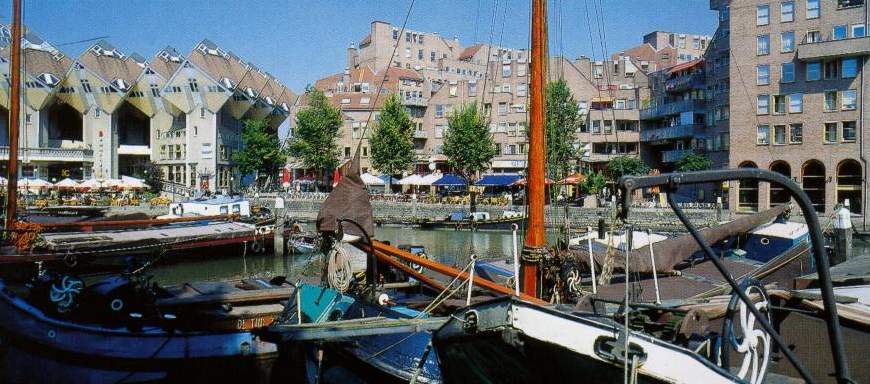
The Oude Haven ('Old harbor') is an excellent place to
spend an afternoon or evening. A large number of bars and restaurants offer plenty of
opportunity to enjoy food, drink and socializing. Note the 'Cubes' (see above) on the left
side of the (full-size) picture.
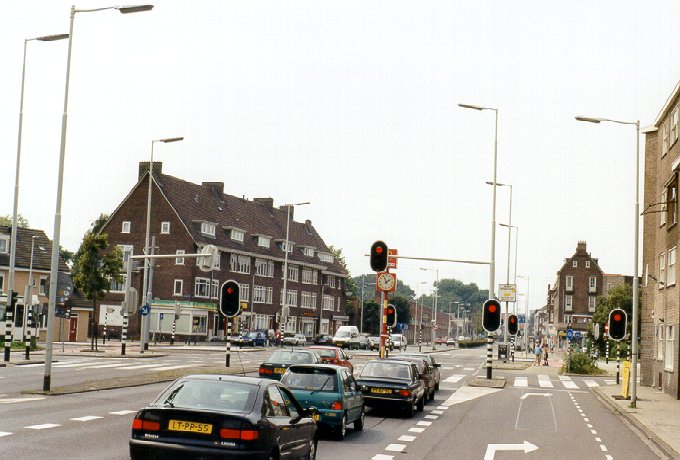 |
Rotterdam Zuid: Strevelsweg (Feyenoord) |
Unlike
the heart of Rotterdam, Rotterdam Zuid did not suffer complete destruction during the war.
Plenty of pre-war buildings survive, which gives this part of Rotterdam its special
atmosphere. This picture was taken in the Feyenoord district, near the Feyenoord soccer stadium. Feyenoord got its name
from the executioner Feye ('oord' means 'place'), as the Dutch admiralty used to have its
gallows there. In those days it was also called Galligoord ('Gallows place').
Although the heart of Rotterdam has primarily become a business district, living in Rotterdam is still very well possible, in all forms, shapes and sizes. Of course many people live in one of the towns around Rotterdam (see also the 'Randstand & Rijnmond' page) but some prefer the city itself, and wouldn't want to live anywhere else for all the money in the world.
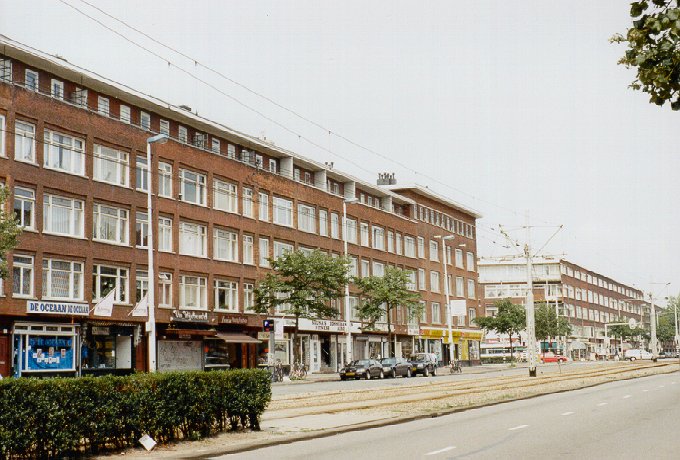 |
Appartments at the Schiekade |
Although
the destruction in 1940 was complete in the heart of the city, many houses in the
districts surrounding it were spared. Most of them are still in use.
This style used to be quite common: shops on the ground floor, apartments on the upper
floors.
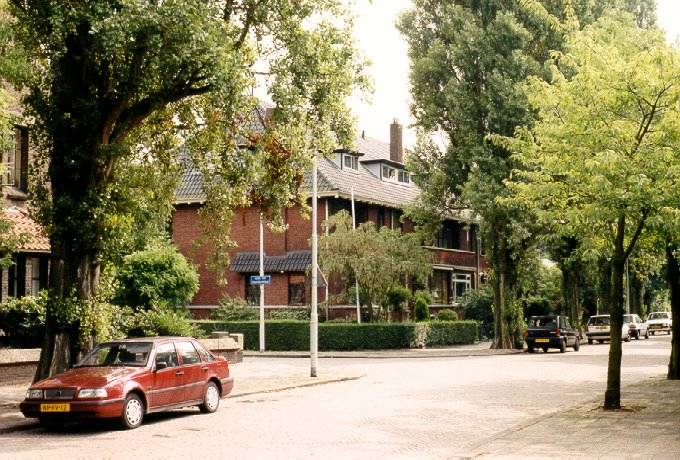 |
Hillegersberg: Statensingel |
By
contrast, Hillegersberg is a district with
stately mansions, wide streets and old trees. Only a few blocks away from the heart of the
city, it has its own distinct, relaxed atmosphere.
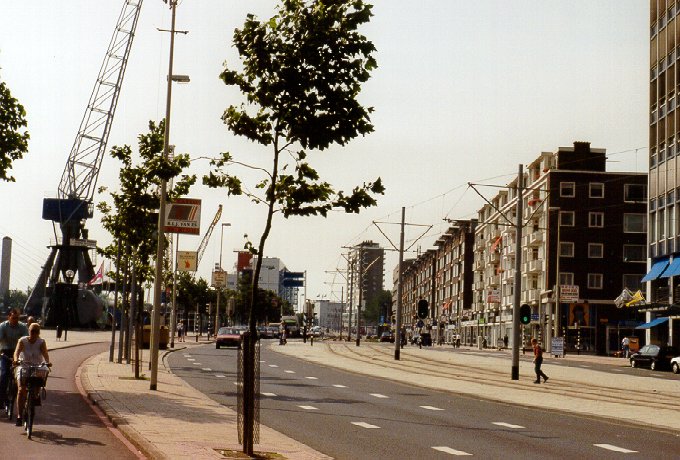 |
Opposite the Leuvehaven |
A room
with a view: the houses opposite Leuvehaven
('Leuve harbor') oversee the harbor and the Maas, and are much in demand. They're also
among the most expensive ones in Rotterdam. Many of them were built before the war, but
have been extensively renovated.
| |
Goudsesingel |
Modern
apartments are also available. The ones at the Goudsesingel
are recent, roomy and quite luxurious.
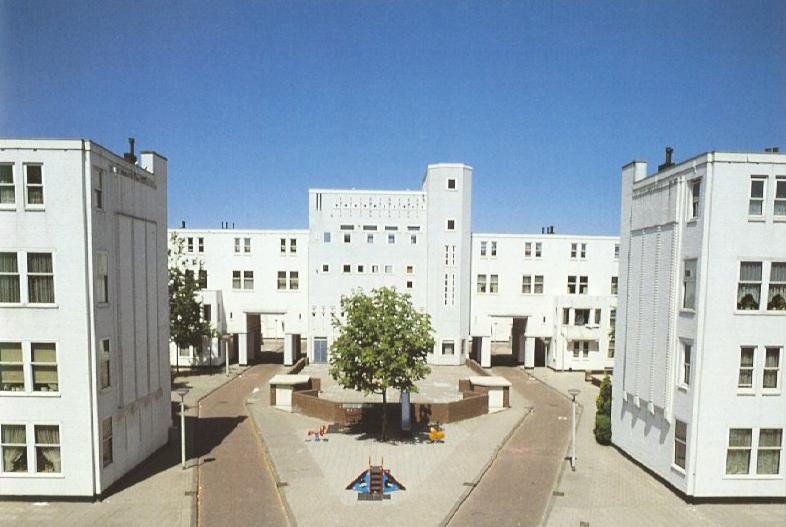 |
Spangen: Light and space |
This
picture was taken in the Spangen district.
Much of Spangen has been renovated, and older blocks have been torn down to make way for
new houses. A modern, yet easy style dominates this block, with the intention to create an
atmoshphere of light and space.
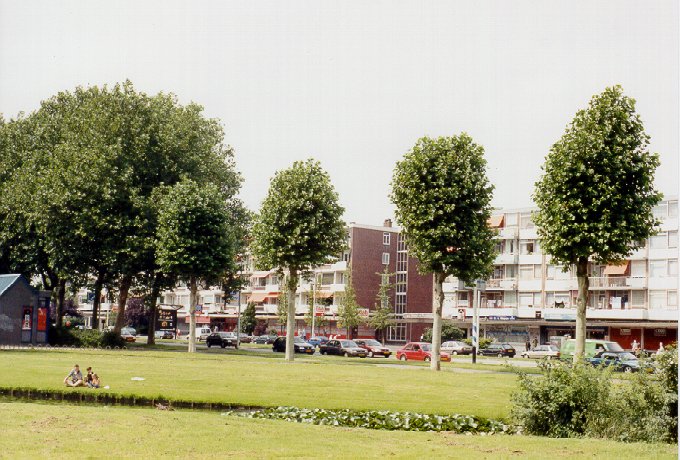 |
Rotterdam Zuid: Spinozaweg |
The
newer parts of Rotterdam Zuid also have their own distinct flavour. Large open spaces with
parks, ponds and trees make it an enjoyable place to live.
Of course, these are only a few pictures. There's just so much to see, and there are so
many different aspects to the city. And the city changes every day. Rotterdam is
impossible to capture on film, it's changing so rapidly. It's a truly dynamic city, a city
with a thousand, ever-changing faces.