About paintings and the Dutch coutryside

Holland and Haarlem in pictures


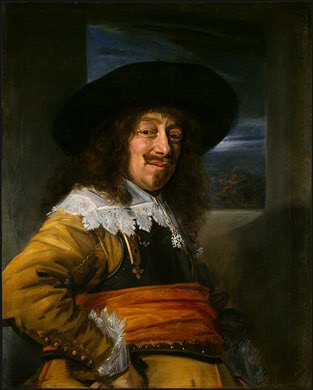
The famous painter Frans Hals of Haarlem

Frans Hals (circa 1580-1666) was as a Dutch painter one of the greatest masters of the art of portraiture, much admired for his brilliant lighting effects and the freedom of his brushwork.

Hals was born in Antwerp, Belgium, and probably trained by the Dutch painter Karel van Mander. He spent all of his adult life in Haarlem, the Netherlands, finding patronage with the wealthy middle-class merchants and burghers of his time. Throughout his life he received important commissions for group portraits of the officers and corporations of Haarlem; toward the end of his life he was granted a small pension by the city. He died September 1, 1666, in what is now the Frans Hals Museum in Haarlem.
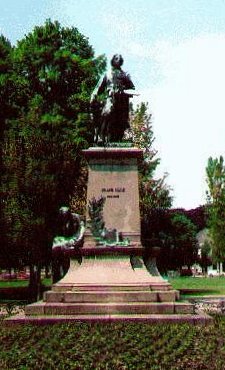
The statue of Frans Hals in Haarlem

In all of his portraits Hals achieved an air of complete spontaneity; his subjects give the impression of being caught in a fleeting, but characteristic, pose and expression. The gay mood of the early work The Laughing Cavalier (1624, Wallace Collection, London), the subject's apparently momentary smile and stance, demonstrate Hals's ability to attain the immediacy of a sketch by the use of rapid, spontaneous brushstrokes. The broad brushstroke is characteristic of his work and adds a robust and lively quality to his portraits, particularly to the genre or character pieces he painted from 1620 to 1640. One of the most famous, the portrait of the gypsy tavern girl La bohémienne (1630, Louvre, Paris) owes its gaiety and brightness to two other painting techniques Hals employed: fully illuminating the figures with direct light, and blending the brilliant colors directly on the canvas.

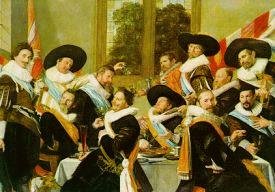
The Haarlem burgher guards


Although his portraits appear spontaneous and uncalculated, Hals was an expert technician, and his studies are always skillfully composed. His talent is particularly evident in his nine group portraits of the burgher guards and corporations of Haarlem, all of which are now in the Frans Hals Museum. In these group portraits Hals demonstrates his ability to catch each man in a characteristic pose, thus giving the group an air of informality and naturalness; each individual is clearly portrayed, yet all are linked in a well-balanced pattern in line and color.
Click to enlarge

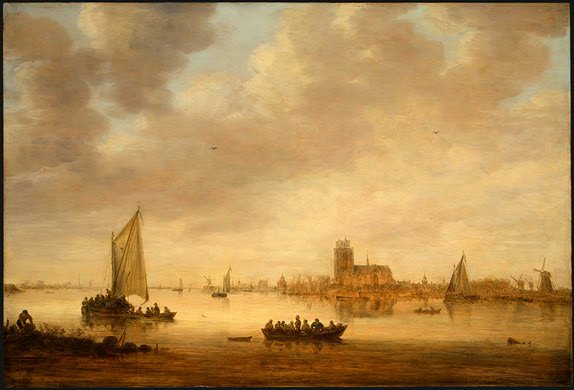
Jan van Goyen, 1644: The Kil at Dordrecht

Jan Josephszoon van Goyen (Leiden 1596 - The Hague 1656) was the son of a shoemaker from Leiden. Around 1616, he came to the wealthy town of Haarlem in northern Holland as a novice painter to be a student of Esaias van de Velde, a landscape painter. Van de Velde was in the process of developing the traditional Flemish-style landscape painting into a clearer illustration of the special features of the Dutch scene and he triggered off van Goyen's career as a painter. Van Goyen returned to Leiden in 1618, but he maintained close contacts with the landscapists in Haarlem. In the 1620s, a new way of presenting typical Dutch scenery - barren sand banks, road-sides, seashore and peaceful rivers - was being developed in Haarlem. The composition was harmonious and often diagonally counterbalanced using only a few colours, usually shades of brown and grey.

Click to enlarge

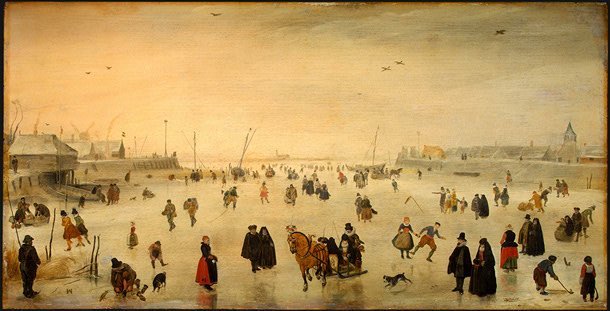
Hendrick Averkamp, 1625: Winter Landscape

Hendrick Averkamp (1585-1634) was the earliest Practitioner of winter landscape painting in the Northern Netherlands in the 17th century. His work is represented in the collections of most major museums, including The National Gallery in London. Averkamp is well known by his close observation of nature and characterisation of his figures. Winter landscapes are one of his favourite subjects.


Click to enlarge

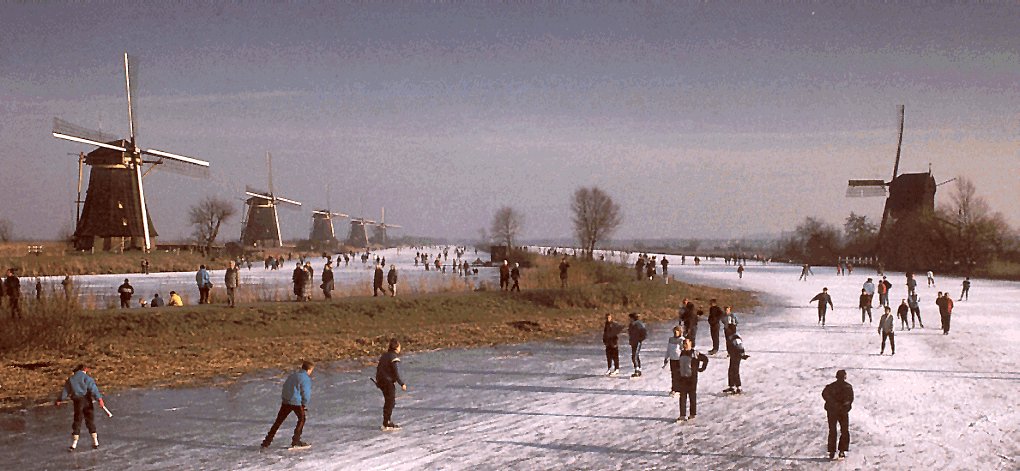
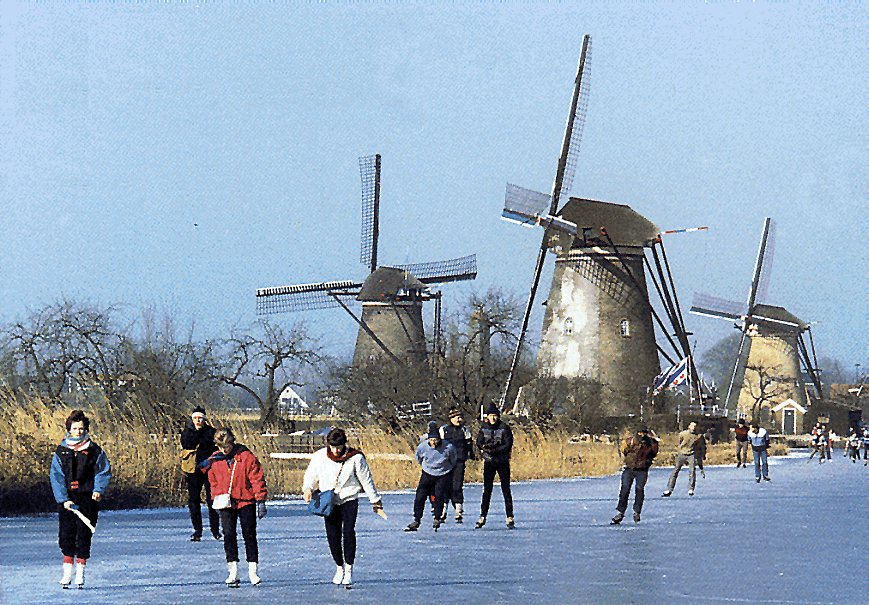
Winterjoy in Holland: many people are skating on the frozen canals

Things did not change very much over the ages. This recent view of scating people at Kinderdijk (near The Hague) looks so much the same as Hendrick Averkamp's painting 250 years before. The ice on the frozen canals is tremendous and each winter many tours are organized, some of over 100 miles scating. Cold ? Not really, it is seldomly below 10 degrees centigrade.
Click to enlarge

Winterjoy in Holland: look at the beautiful windmills

The mills at Kinderdijk are among the most beautiful windmills in Holland. These mills serve for pumping the water out of the 'polders', the land below sealevel.

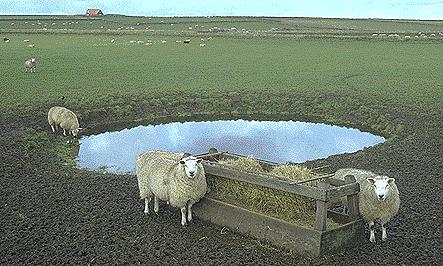
Sheep in the Schermer polder

Ans father had the occupation of sheep haircutting (He has retired now, but he still serves his old friends among the farmers: it is hard to quit from the work you love)

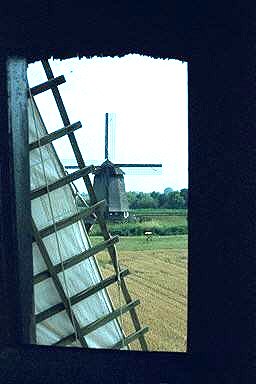
Looking out of a windmill in the Schermer polder


Back to the top of this page